Foreword.
A dissertation is an image.
Jungian analyst Patricia Berry observes, An image is simultaneous … all parts are involved with each other
such that every part …
is concurrently present.
footnote 1 Though Berry is speaking of nighttime dreams, I have come to believe that a dissertation, too,
is best understood as a single image. Though the researcher moves through linear time, assembling pieces as she goes — areas of inquiry, methodology,
relevant literature, insights — in the end, each aspect of the opus becomes inseparably linked to every other part of the work.
Because of this simultaneity, I find myself at an impasse. True, my dissertation was once a collection of questions and false starts, a chaos of marginalia. But now, completed, it is a single image and I feel a need to present it in that way. Unfortunately, I am bound to sequentiality. No matter how I coax it, my pen will not write in four dimensions.
There is nothing for it, then, but to start somewhere and to admit that the view will necessarily remain partial for some time to come. It will be some pages before the image really begins to take shape on the page or in the reader’s mind.
And so I ask, friendly reader, for your patience with my limitations as a linear woman in possession of a mundane writing device. It is my hope, and my intention, that the full image will soon take shape as a single, simultaneous vision.
Introduction.
Telic takeover.
This dissertation started with an interest in the Jungian personal complex and how it expresses in gifted individuals (‘gifteds’). But as I explored the complexes of the gifted, combed the literature, and contemplated my research journey as a whole, telos began to arise at every turn. Perhaps it was the press of Ananke, the deity of Necessity, casting a spotlight in the direction of telos. Or it might have been the autonomous will of the opus, itself, if one can imagine a research project in possession of its own aim. But whatever the cause, this dissertation has become an exploration of telos in the complexes of the gifted. And I, obedient to both the data and to Necessity, have welcomed the warm torchlight of Ananke.
Telos: A far-reaching phenomenon.
If we combine telos with a bit of logos, meaning reason,
footnote 3 we create teleology, which reads whatever happens in life as confirming a long
range vision.
footnote 4 Whenever we assume a large-scale telos — something, perhaps, along the lines of a divine or transcendental will — we are engaged in teleology.footnote 5
Telos does not have to be complicated. When I go to the library, I have a telos: I plan to check out a book. Telos, also, does not require consciousness. It could be argued, for instance, that the process of evolution bears a telos: the aim of the survival or perpetuation of life. For the purposes of this paper, however, I will understand telos to imply some form of consciousness and a certain degree of complexity. In particular, I will consider the telos which expresses in or through gifted persons, their personal complexes, and their projects.
Additionally, as I present this dissertation, I will consider the telos inherent in it: in its methodology, its phases and development, and, in some sense, in the very opus, itself. The attention to telos will radiate throughout all aspects of this project, including and especially in its central image, that of the torch-bearer.
The motif of the torch-bearer .
In 1946, C.G. Jung published an essay entitled The Gifted Child.
footnote 6 I will discuss that paper in my literature review below,
but for now I would like to highlight its final sentence: The gifted ones … are the torch-bearers, chosen for that high office by nature herself.
footnote 7
An exploration of Jung’s gifted torch-bearer image will require a preliminary definition of giftedness. Qualitatively and phenomenologically, the gifted person is
a quick and clever thinker who is able to deal with complex matters. An individual who is autonomous, curious and passionate. A sensitive and emotionally rich person
who is living intensely. He or she is a person who enjoys being creative.
footnote 8 By way of their intensity, complexity and drive
footnote 9 the gifted often
find themselves taking up the torch of new ideas, sharing those concepts with others, and — as a result — leading the wider culture into new terrain.
Fred Rogers, who developed and starred in the American Public Television show Mister Rogers’ Neighborhood, was a torchbearer of this sort. Far more than a warmhearted celebrity, Rogers was a gifted polymath: musician, puppeteer, minister, lifelong student of childhood development, and advocate for television as a vehicle for education.footnote 10 To be a child in Rogers’ television community was to live — if only for thirty minutes at a time — in a world where people of diverse gender, backgrounds, and ability are equally deserving of respect and care. In this way, Rogers blazed a path that we continue to wear smooth today. A powerful telos moved through him and a kinder world was awakened in the hearts of children.
Another torch-bearer, Carl Jung — who came out as gifted, himself, in The Gifted Child
footnote 11 — threw light on the nature of the unconscious,
including the centrality of the complex.footnote 12 More, he was a torch-bearer for the concept of telos. There are no purposeless psychic processes,
Jung writes.footnote 13 Life is teleology par excellence; it is a series of aims that seek to fulfill themselves.
footnote 14 To Jung, our entire human experience is a telic
journey — a stance borne out in his concept of individuation and the related figure known as the Self.footnote 15 Briefly defined, individuation is that
lifelong process aimed at coming into the fullness of one’s own being.
footnote 16 The Self, meanwhile, is an inner guiding figure
footnote 17 responsible for
the progressive development of consciousness throughout the life span.
footnote 18 The Self might even be understood as a teleological figure in the fullest
sense of the word, if we envision it as expressing its autonomy across the lifetime, drawing us towards the death that belongs to [our] destiny.
footnote 19
Jung has been a torch-bearer in other ways, too. Kuzmicki and Błocian note that the Jungian conception of psyche is among the most quoted and commented
on among contemporary psychological theories.
footnote 20 Meanwhile, Darowski and Darowski cite Jung’s ongoing influence in storytelling and popular culture.footnote 21
In essence, torch-bearers like Rogers and Jung illuminate a way forward — intellectual, cultural, ethical, and beyond. First, each was a torch-bearer carrying a personal telos — a driving interest — which they shared with the world. Second, each served as a human vehicle of the sort of telos present in phenomena like the zeitgeist.
But the gifted person as torch-bearer is only the first of the two lampadephoricfootnote 22 images featured in this dissertation, however. The second comes by way of James Hillman’s paean
to telos, The Soul’s Code.footnote 23 Here, Hillman invokes Plato’s myth of Er, which tells a story of how, between incarnations, human souls
determine their upcoming lifetimes by selecting lots.footnote 24 These lots are then ‘sealed’ as fate when souls pass beneath the throne of Necessity,
who is the goddess
Ananke.footnote 25 Necessity, the personification of a principle of cosmic purposiveness,
footnote 26 is so powerful that even the gods do not
fight against Ananke.
footnote 27 She is an archetypal image of telos and one of the great cosmic forces.
footnote 28
Because of Plato’s depiction of Ananke in the myth of Er, we tend to think of Necessity as employing a spindle.footnote 29 But in what may be the only ancient representation of
the goddess,
footnote 30 we actually see her bearing a torch:
Ananke
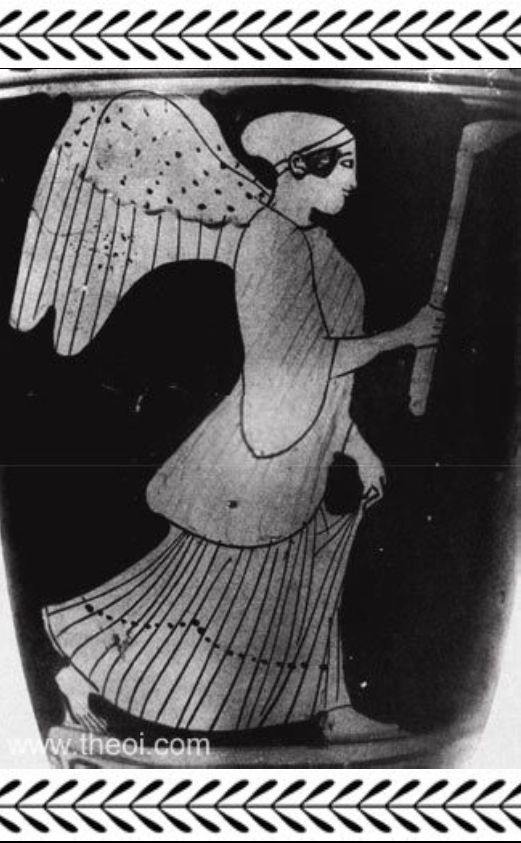
Image source: Theoi Project
The torch-bearing Ananke does not face the viewer, but is clearly depicted mid-step — perhaps an invitation to the viewer to follow her. The flame of her torch, rather than being blown backward by her forward progress, ‘points’ toward her destination. This is clearly an image of a woman going somewhere — a goddess with a distinct telos. In fact, she is so set on her destination that, should an obstruction appear on the path, she has wings to take flight and speed Necessity on its way.
I will return to both the gifted torch-bearer and Ananke later in this paper. But before I close this section, it is worth noting that the synchronicity between these torch-bearing images — Jung’s and Ananke’s — arose suddenly, unplanned and unsought. When the pair of them simultaneously showed themselves, I felt fairly bowled over! Now, looking back, it almost seems as if there had been a telos in place, an aim to spotlight these torch-bearer images, all along.